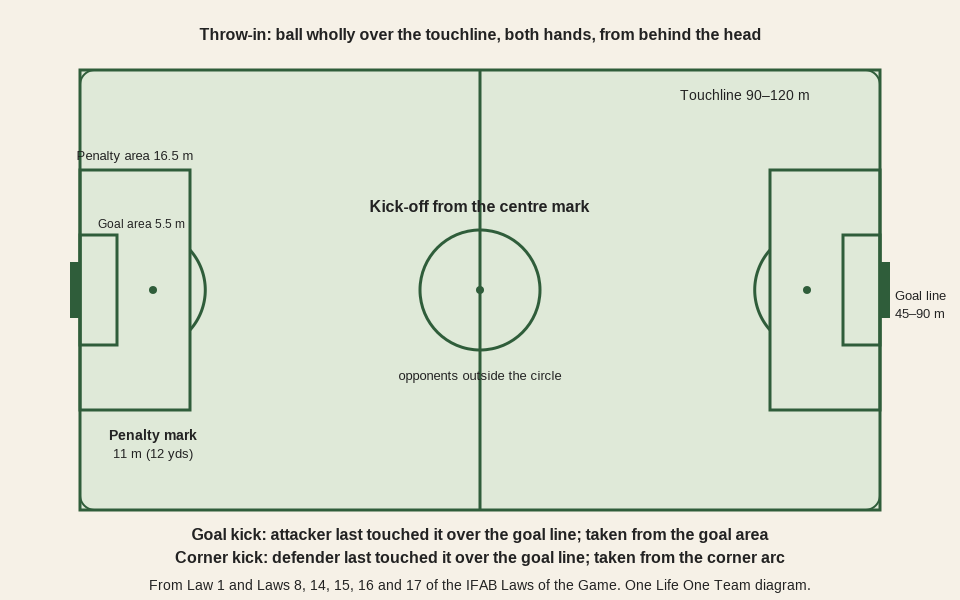
Field of play diagram drawn for One Life One Team; free to reuse with a link to this page
Football Rules Explained: The 17 Laws, Read from the Book
Football, or soccer, is played by two teams of eleven who try to send the whole ball over the goal line, between the posts and under the bar. A match is two halves of 45 minutes plus the time the referee adds, and the International Football Association Board (IFAB) writes the 17 Laws of the Game. This guide reads them from the law book itself.
One warning first: searches for "football rules" often return American gridiron pages full of quarters and downs. This is association football, the game played from the Premier League to the World Cup. If a word is new, our plain-English glossary will help.
How you win
A goal is scored when the whole of the ball passes over the goal line, between the goalposts and under the crossbar, provided the scoring team has committed no offence first; kicked, headed or deflected makes no difference. More goals wins, equal goals is a draw. Three points for a win is a competition rule, not a Law: the Laws only say that where a winner is needed after a draw, the permitted ways are the away-goals rule, extra time and a penalty shoot-out. There is no clock stoppage; play flows until the ball leaves the pitch or the referee stops it.
Who makes the rules: the 17 Laws
The IFAB, founded by the four British associations and now including FIFA, reviews the Laws every year and publishes the changes before each season. The referee has full authority to enforce them and decides on their own opinion and the spirit of the game; competitions may add technology such as VAR and set match length, substitutions and extra time within the Laws.
| Law | What it covers |
|---|---|
| 1 The field of play | Markings |
| 2 The ball | Size |
| 3 The players | Eleven a side |
| 4 The players' equipment | Kit |
| 5 The referee | Authority and decisions |
| 6 The other match officials | Assistants |
| 7 The duration of the match | Halves |
| 8 The start and restart of play | Kick-off |
| 9 The ball in and out of play | When play stops |
| 10 Determining the outcome | Goals |
| 11 Offside | Position and offence |
| 12 Fouls and misconduct | Free kicks |
| 13 Free kicks | Direct and indirect |
| 14 The penalty kick | Procedure |
| 15 The throw-in | Procedure |
| 16 The goal kick | Procedure |
| 17 The corner kick | Procedure |
The pitch, the ball and the players
The pitch is a rectangle whose touchline is longer than its goal line: 90 to 120 metres by 45 to 90, and for internationals 100 to 110 by 64 to 75. The goal area extends 5.5 metres from each post, the penalty area 16.5 metres, the penalty mark is 11 metres out and the centre circle has a radius of 9.15 metres; the diagram above puts each restart where it belongs. The ball is 68 to 70 centimetres round and weighs 410 to 450 grams.
Each team has at most eleven players, one the goalkeeper, and a match cannot start or continue with fewer than seven. The game lasts two equal halves of 45 minutes with a half-time of at most 15. The referee adds time for substitutions, injuries, time-wasting, cards, VAR checks, goal celebrations and any other delay; the figure on the board is a minimum, which the referee may increase but never cut.
Starts, restarts and the ball out of play
A coin toss decides who kicks off and which goal each team attacks; the side that conceded restarts after a goal. The ball is out of play only when the whole of it has crossed the goal line or touchline, on the ground or in the air, or when the referee stops play; a ball that hits the referee and starts a promising attack, changes possession or goes in brings a dropped ball.
The restarts follow one pattern. Over the touchline: a throw-in to the team that did not touch it last, both hands from behind the head, feet on or behind the line, opponents two metres away. Over the goal line off an attacker: a goal kick from anywhere in the goal area, opponents outside the penalty area. Off a defender: a corner from the arc, opponents 9.15 metres back. The referee's raised arm means an indirect free kick, and an indirect free kick kicked straight in is a goal kick, not a goal.
Fouls, handball and cards
A direct free kick is given for charging, jumping at, kicking, pushing, striking, tackling or tripping an opponent in a way the referee judges careless, reckless or using excessive force, and for holding, impeding with contact, spitting and handball. Those three words decide the card: careless needs none, reckless is a caution, excessive force is a sending-off. Not every touch of the arm is handball: the offence is a deliberate touch, an arm that has made the body unnaturally bigger, or a goal scored straight from the arm even by accident. A goalkeeper who holds the ball for more than eight seconds concedes a corner.
A yellow card is a caution: delaying a restart, dissent, entering or leaving the pitch without permission, persistent offences and unsporting behaviour, including simulation; two in one match make a red. A straight red is for serious foul play, violent conduct, biting or spitting, offensive language, and denying an obvious goal-scoring opportunity by a foul or a deliberate handball.
Offside in one paragraph
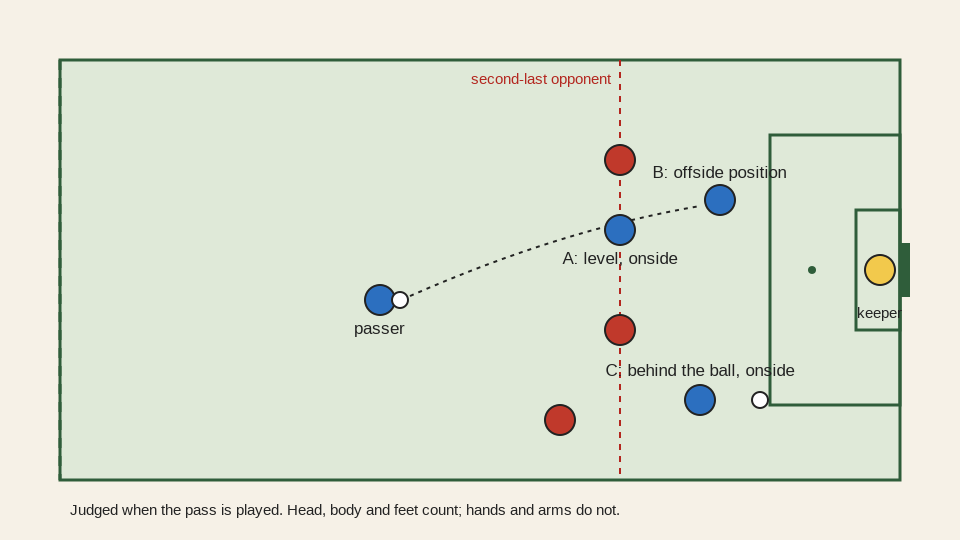
A player is in an offside position if any part of the head, body or feet is in the opponents' half and nearer their goal line than both the ball and the second-last opponent when a team-mate plays the ball; arms do not count and level is onside. Being there is not an offence: the player must become involved, by playing the ball, interfering with an opponent or gaining an advantage from a rebound or a save. There is no offside straight from a goal kick, throw-in or corner. The whole law, with diagrams, is in our offside guide.
The penalty kick
The ball sits on the penalty mark and the goalkeeper must stay on the goal line, facing the kicker, with part of one foot on or behind the line when the ball is kicked. Everyone else stands at least 9.15 metres away, behind the mark and outside the area. The kick must go forward and the kicker may not touch the ball again until someone else has. If a defender offends and the kick is missed, it is retaken.
VAR and the referee's decision
The video assistant referee may help only with a clear and obvious error or a serious missed incident in four areas: goal or no goal, penalty or no penalty, a direct red card, and mistaken identity. The referee gives a decision first, only the referee can start a review and the referee decides, with no time limit. For whether the ball crossed the line, see how goal-line technology works.
Where to read the Laws next
The IFAB publishes the full text of every Law on its own site; check it whenever a decision surprises you. The Laws say what happens on the pitch, not how teams set up within it: for that, read our guide to formations.
Try Freeze Frame
You are the matchday photographer. Five moments, one shutter press each: the save, the header, the ball on the line, the overhead kick and the terrace. How perfectly timed are you?
Sources and further reading
Pages we opened when writing this article, last checked 11 November 2026. They open in a new tab, and we are not responsible for what other sites publish.
- IFAB Laws of the Game 2026/27, Law 1: The field of play — Touchline 90–120 m, goal line 45–90 m, international 100–110 m by 64–75 m, goal area 5.5 m, penalty area 16.5 m, penalty mark 11 m, centre circle 9.15 m.
- Law 2: The ball — Circumference 68–70 cm, weight 410–450 g at the start.
- Law 3: The players — Eleven a side with a goalkeeper, no match with fewer than seven, the substitution procedure.
- Law 5: The referee — Full authority; decisions on the referee's opinion and the spirit of the game; technology may assist.
- Law 7: The duration of the match — Two halves of 45 minutes, half-time up to 15, what added time covers, the board shows a minimum, a penalty extends the half.
- Law 8: The start and restart of play — The coin toss and the kick-off; the dropped ball.
- Law 9: The ball in and out of play — The whole ball over the line; the ball touching the referee and the dropped ball.
- Law 10: Determining the outcome of a match — A goal is the whole ball over the line with no offence; the winner; away goals, extra time and penalties as the only tie-breakers; the shoot-out procedure.
- Law 11: Offside — Offside position and the offence, in one paragraph here.
- Law 12: Fouls and misconduct — Careless, reckless and excessive force; the direct free kick offences; handball; the goalkeeper's eight seconds; the cautionable and sending-off offences.
- Law 13: Free kicks — Direct and indirect; the raised arm; an indirect free kick straight in is a goal kick.
- Law 14: The penalty kick — The ball on the mark, the goalkeeper on the line, everyone else 9.15 m away and behind the mark, the kick forward, the retake.
- Law 15: The throw-in — Facing the field, feet on or behind the line, both hands from behind and over the head, opponents 2 m away.
- Law 16: The goal kick — From anywhere in the goal area, opponents outside the penalty area, the five-second countdown for delay.
- Law 17: The corner kick — From the corner area, opponents 9.15 m away, the ball need not leave the arc.
- Video assistant referee (VAR) protocol — The four reviewable decisions, clear and obvious error, the referee's final say, no time limit.
This article was written with the help of AI. Before publication, automated checks confirmed that every listed source was opened and every picture is credited. Spotted a mistake? Write to hello@inkhorses.com.
More articles
The Offside Rule Explained, from Law 11 Itself
The offside rule explained from Law 11: offside position, the three questions that make it an offence, the exceptions, the history and what VAR does.

VAR Football Explained: How Video Review Works
VAR football explained: a video team checks goals, penalties, direct red cards and mistaken identity, but cannot overturn yellow cards or most fouls.

Football Formations Explained: From the Pyramid to the Press
From the 2-3-5 pyramid to the 4-2-3-1: how football formations are numbered, why they changed, and what the numbers do and do not tell you.